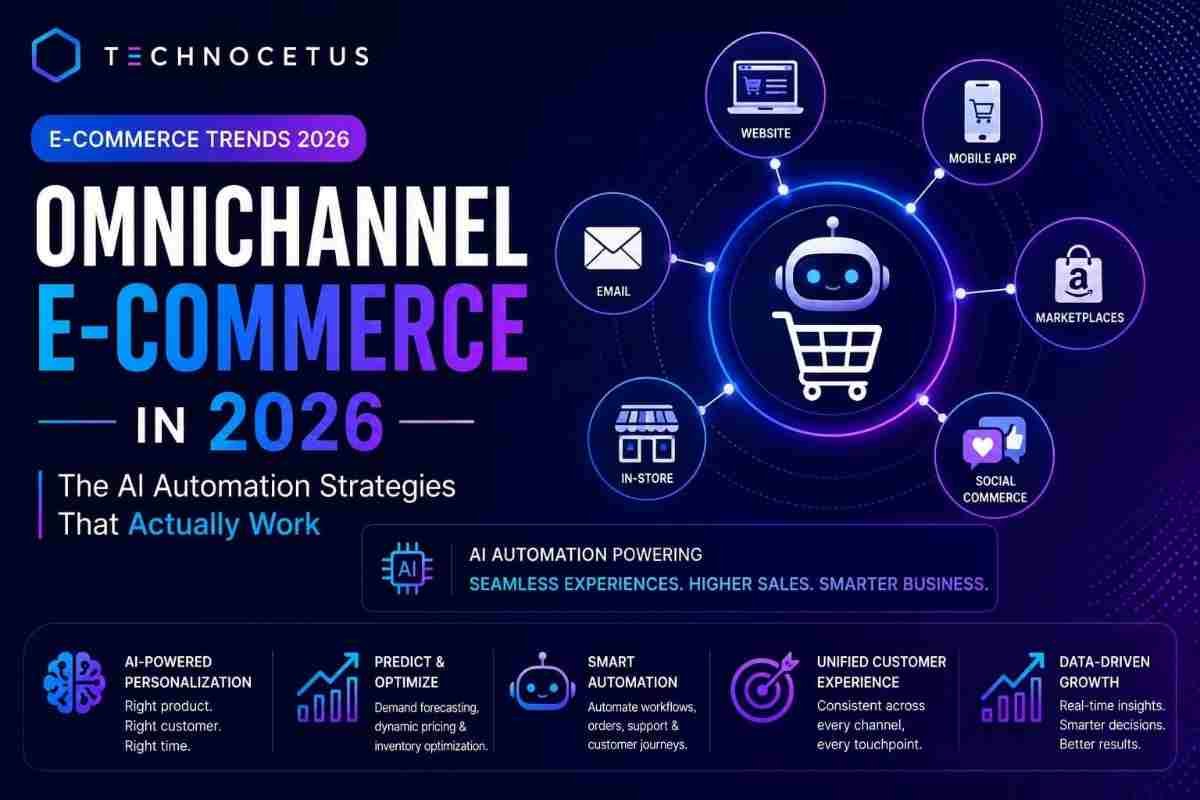
Omnichannel E-Commerce in 2026: What Works — And How AI Automation Is Making It Finally Possible
A customer spots a jacket on Instagram. She saves it. Three hours later, she walks past your physical store, opens your app, and the jacket is waiting in her digital cart — her size, her color, flagged as low stock. She buys it in 40 seconds. She never spoke to anyone. She's delighted.
That experience isn't aspirational anymore. It's the baseline expectation. And for the vast majority of retailers still operating disconnected channels with siloed data systems, it's an expectation they're failing to meet — at enormous cost.
Here's the uncomfortable truth: most "omnichannel" strategies in practice are multichannel strategies with better marketing copy. The inventory doesn't sync. The loyalty points don't transfer. The customer service agent has no idea what she browsed online yesterday. The seams show, and customers walk.
What's changed in 2026 is that AI automation has finally closed the gap between omnichannel ambition and omnichannel execution. This post breaks down what actually works, where the opportunities are, what the risks look like, and what leaders need to do right now.
The State of Omnichannel in 2026: What the Data Says
The definition of "omnichannel" has evolved. It's no longer enough to be present on multiple platforms — customers now expect a unified, intelligent experience that adapts to context, history, and intent in real time.
According to Harvard Business Review research, omnichannel customers spend 10% more online and 4% more in-store than single-channel shoppers — and they're 23% more likely to return. The revenue case is settled. The execution gap is where the money is being left on the table.
What's different in 2026 is the technology stack available to close that gap:
- Generative AI creates personalized content, recommendations, and responses at scale across every channel simultaneously
- Machine learning models unify behavioral signals from web, app, in-store, and social into a single customer intelligence layer
- Real-time data infrastructure (enabled by composable commerce architectures) means inventory, pricing, and promotions are synchronized in milliseconds — not overnight batch jobs
The retailers winning today aren't the biggest — they're the ones who've invested in AI-first omnichannel infrastructure.
What Actually Works: The 5 Pillars of Effective Omnichannel in 2026
1. Unified Customer Data Platform (CDP) Powered by Machine Learning
The single biggest predictor of omnichannel success is data unification. Without a real-time, AI-enriched view of each customer across touchpoints, every other investment is built on sand.
Modern machine learning-powered CDPs go beyond collecting data — they:
- Resolve identity across anonymous sessions, logged-in users, email subscribers, and in-store loyalty members into a single profile
- Predict next-best-action — what channel, what message, what product to surface next for each individual
- Score churn risk and upsell potential continuously, enabling proactive intervention before a customer disengages
Brands using ML-powered CDPs report 25–35% improvements in email open rates and 15–20% reductions in churn within 12 months of deployment. The data advantage compounds — the longer you run it, the better your models get.
2. AI-Driven Personalization at Channel-Specific Scale
Generic personalization ("Hi [First Name], you might also like…") is table stakes. What works in 2026 is context-aware, channel-specific personalization powered by generative AI:
- Email: dynamic content blocks generated individually for each recipient based on browse history, purchase cadence, and predicted intent
- Mobile push: timing and message tone adapted to individual behavioral patterns — the AI learns that this customer responds to urgency messaging on Tuesday mornings but ignores it on weekends
- In-store digital: clienteling apps give sales associates real-time AI-generated briefings on each loyalty member who walks in — their online wishlist, their size, their last return, their preferred price range
- Social commerce: AI-generated product captions and creative variants tested and optimized in real time across Instagram, TikTok Shop, and Pinterest
See our guide on building a generative AI personalization engine for e-commerce →
3. Inventory Intelligence and Real-Time Fulfillment Orchestration
Nothing destroys an omnichannel experience faster than showing a customer an available product that isn't actually available. And nothing frustrates a retailer more than carrying inventory in the wrong location while stockouts happen elsewhere.
AI automation applied to inventory management is solving both problems:
- Demand forecasting models that account for channel mix, weather, social trends, and local events — predicting where demand will occur before it happens
- Dynamic fulfillment routing that selects ship-from-store vs. warehouse vs. dropship in real time based on cost, speed, and customer expectation
- Automated replenishment triggers that prevent stockouts without requiring manual intervention
Zara's AI-powered inventory system — one of the most studied in retail — achieves near-real-time stock alignment across 2,000+ global stores, reducing markdowns by an estimated 25% annually.
4. Conversational Commerce Across Every Channel
The future of work in retail customer service isn't agents answering phones — it's AI handling the vast majority of interactions across every channel with human agents reserving their attention for complex, high-value situations.
What works in 2026:
- WhatsApp and iMessage commerce bots that handle product discovery, order status, returns, and upsells in natural conversation
- AI-powered live chat that uses generative AI to draft agent responses in real time, cutting handle time by 40–60% while maintaining quality
- Voice AI in IVR systems that resolve inquiries without menu navigation — customers describe their issue in plain language and the AI routes and resolves
The key distinction: these systems work because they share context across channels. A customer who chatted with the bot yesterday doesn't need to repeat themselves when they call today.
5. Social Commerce Integration: Where Discovery Happens Now
In 2026, the purchase journey often begins on TikTok, Instagram Reels, or Pinterest — not on your website. Brands that treat social as a traffic source to their e-commerce site are leaving conversion on the table. The winning strategy is meeting customers where the discovery happens.
TikTok Shop's AI-powered product matching surfaces relevant products to users before they search — predictive commerce at scale. Brands with native TikTok Shop integrations report conversion rates 2–4x higher than link-in-bio traffic to traditional PDPs.
Real-World Case Studies: Omnichannel Done Right
Nike's Connected Membership Program integrates app, web, and in-store into a single data ecosystem. Members receive AI-personalized product releases, in-store reservation capabilities, and personalized training content — all tied to a unified profile. Nike Direct revenue (driven heavily by this omnichannel approach) now represents over 40% of total company revenue.
Sephora's Beauty Insider uses machine learning to recommend products across web, app, and in-store simultaneously. Their Beauty Advisor tools give in-store staff access to each customer's online browse history and AI-generated recommendations — eliminating the in-store/online divide entirely. The program drives industry-leading loyalty metrics with 34 million active members.
IKEA's AI-Powered Space Planning tool — available on web, app, and in-store kiosks — uses generative AI to help customers visualize furniture in their actual rooms. Customers who use the planning tool convert at 3x the rate of non-users, and their average order value is significantly higher.
External resource: The Salesforce State of Commerce 2025 Report provides deep benchmarking data on omnichannel performance across 4,000+ commerce leaders globally.
The Challenges: Ethics, Bias, and Regulation in Omnichannel AI
The same AI capabilities that make great omnichannel experiences possible also introduce significant responsibilities.
Personalization vs. Privacy
The more data you use to personalize, the more exposure you create under GDPR, CCPA, and India's DPDP Act. Hyper-personalization that feels helpful to some customers feels surveillance-like to others — and regulators are paying attention. Consent architecture must be built first, not retrofitted after deployment.
Algorithmic Bias in Recommendations
ML recommendation models trained on historical purchase data can encode and amplify demographic bias — surfacing premium products to certain customer segments and budget options to others based on inferred identity signals. This isn't just an ethical problem; it's a business problem that suppresses revenue from underserved segments. Regular bias audits of recommendation systems should be mandatory, not optional.
The Transparency Gap
Customers increasingly want to know when they're interacting with AI. The EU AI Act requires disclosure in many automated commercial contexts. Brands that are transparent about AI-assisted interactions and give customers meaningful control over their data consistently outperform those that obscure it — trust is a conversion factor.
Data Security in Unified Systems
A unified customer data platform is also a unified risk surface. A breach of a siloed system is damaging. A breach of an integrated CDP containing cross-channel behavioral data, purchase history, and location signals is catastrophic. Security investment must scale with data integration ambition.
The Opportunity: Why the Window Is Still Open
Despite rapid adoption among leading retailers, the majority of mid-market e-commerce businesses still operate with fragmented data, disconnected channels, and manual inventory processes. The gap between leaders and laggards is widening — and it's becoming self-reinforcing.
The businesses that move in the next 12 months will:
- Build proprietary customer data assets that competitors cannot replicate simply by buying the same software
- Establish AI model performance advantages — more data, better predictions, better experiences — that compound quarter over quarter
- Capture organic search and social commerce positions that are significantly harder to displace once held
Actionable Insights: Your Omnichannel Roadmap
For Business Leaders:
- Audit your data fragmentation — map every customer touchpoint and identify where behavioral data is siloed, lost, or delayed; this gap is your biggest revenue leak
- Prioritize CDP investment before channel expansion — adding a sixth channel to a broken data foundation makes the problem worse, not better
- Set omnichannel KPIs that span channels — cross-channel customer LTV, omnichannel conversion rate, and unified NPS, not channel-specific metrics that optimize silos
For E-Commerce and Marketing Teams:
- Run a personalization audit — benchmark your current email, push, and on-site personalization against best-in-class benchmarks; identify the highest-impact gaps
- Pilot social commerce natively — launch a TikTok Shop or Instagram Checkout integration on your top 10 SKUs before scaling; measure incremental conversion, not just traffic
- Build AI-assisted clienteling if you operate physical retail — give your in-store staff mobile tools that surface online behavioral data at the point of interaction
For Technology and Operations Teams:
- Evaluate composable commerce architecture — headless, API-first systems are the infrastructure prerequisite for true omnichannel agility
- Implement real-time inventory visibility as a foundational project — accurate, channel-unified stock data is the prerequisite for every other omnichannel capability
- Establish AI governance policies for recommendation systems and customer data use before scaling automation
The Bottom Line
Omnichannel e-commerce in 2026 isn't a strategy — it's a capability. And the organizations building that capability on a foundation of AI automation, unified data, and ethical governance aren't just creating better customer experiences. They're building structural competitive advantages that will define their category positions for the next decade.
The jacket in the cart. The app that knows her size. The sales associate who remembers her preference. These aren't magic. They're the product of deliberate investment in the right infrastructure, at the right moment.
That moment is now. The retailers who move will define the next era of commerce. The ones who wait will spend it catching up.
Keywords targeted: omnichannel e-commerce 2026, AI automation, machine learning, generative AI, business transformation, future of work