Multi-Agent AI Systems in 2026: How Specialized Agents Solve Complex
Business Problems
Meta description: Learn how researcher, planner, analyst, reviewer, and execution agents collaborate in multi-agent AI systems to solve complex business problems a single agent can't.
Introduction: Why One AI Agent Is Rarely Enough
Artificial intelligence hits the
same wall. A single AI agent given a large, multi-stage task tends to lose
context, skip steps, or miss its own mistakes. That is why multi-agent
systems have become one of the defining artificial intelligence trends
of 2026: instead of one generalist, businesses are building teams of
specialized agents that divide the work and check each other's output.
What Is AI, and Why Does It Matter Today?
Artificial intelligence is
software that performs tasks normally requiring human judgment, such as
understanding language, spotting patterns, and making decisions. Most of it
runs on machine learning, where systems learn from data rather than
following hand-written rules. Generative AI added the ability to produce
text, code, and analysis on demand.
The newest step is agentic AI:
systems that plan, use tools, and act across many steps with little prompting.
This is where AI automation moves from answering questions to completing
work, and it is a major driver of business transformation. Gartner
predicts that up to 40% of enterprise applications will include task-specific
AI agents by the end of 2026, up from under 5% in 2025.
What Is a Multi-Agent System?
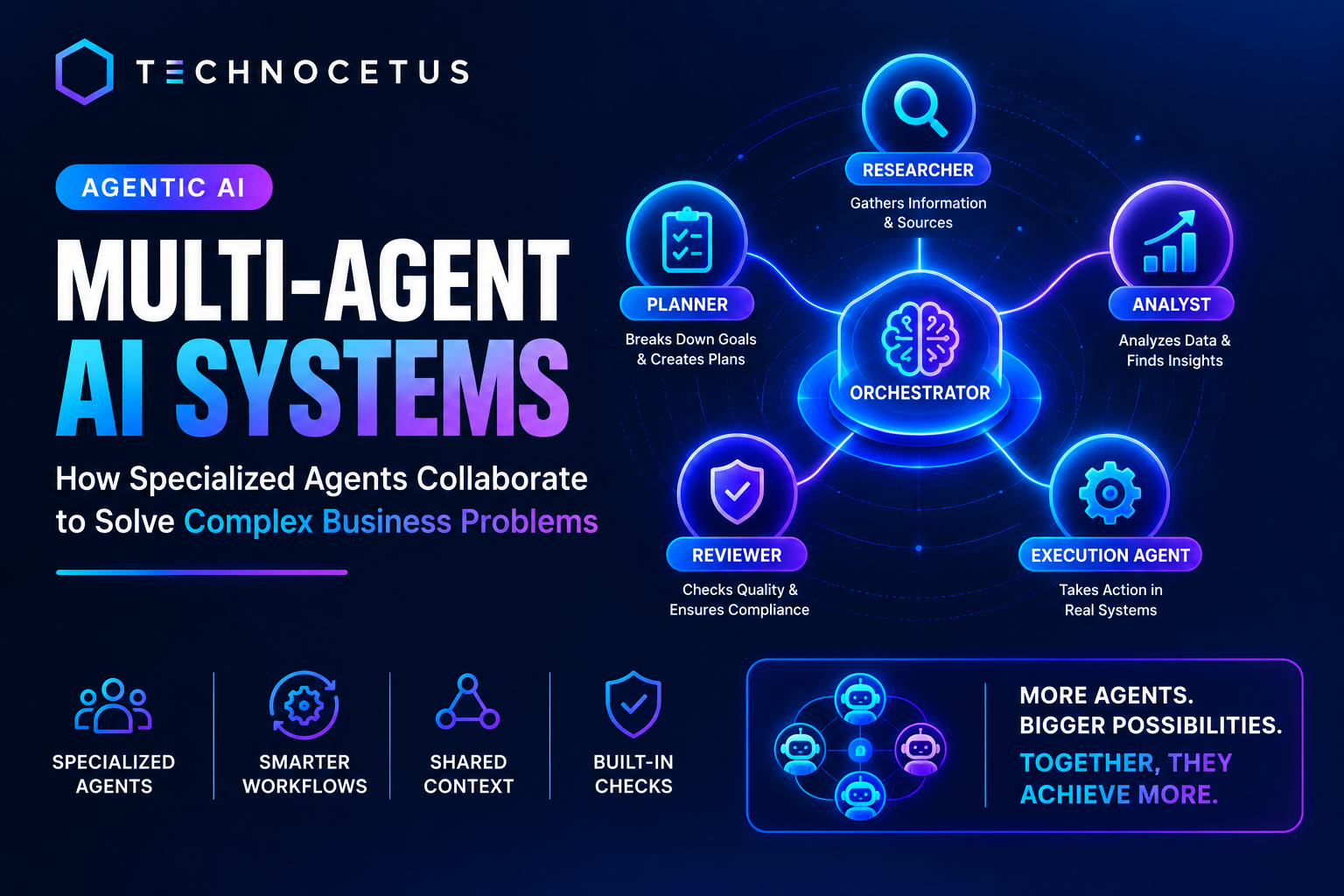
A multi-agent system is an
architecture in which several AI agents, each with its own role, instructions,
and tools, work toward a shared goal. A coordinating layer called the orchestrator
assigns tasks, passes information between agents, and decides when the job is
finished.
Four traits define a good one:
• Specialization:
each agent does one job and is tuned for it
• Coordination:
the orchestrator routes work and manages dependencies
• Shared
context: agents read from and write to common memory, so nothing is lost in
handoffs
• Built-in
checks: dedicated agents review work before it reaches the real world
Meet the Team: The Five Core Agent Roles
Names vary between frameworks,
but most business-ready systems rely on the same five roles.
The Researcher Agent: Gathering the Facts
The researcher is the team's
scout. It pulls market reports, internal documents, and customer records, then
summarizes what it found and where it found it. Its job is to make sure every
other agent works from evidence, not guesses.
The Planner Agent: Turning Goals into Steps
Given an objective like
"cut invoice processing time by 30%," the planner decomposes it into
sub-tasks, sets the order, identifies dependencies, and assigns each step. It
is the project manager of the group.
The Analyst Agent: Making Sense of the Data
The analyst turns raw findings
into decision-ready insight. It compares scenarios, detects anomalies, and
builds forecasts, often using code and spreadsheets for the quantitative work
that conversational models get wrong.
The Reviewer Agent: The Quality Gate
This is the role single-agent
setups usually lack. The reviewer checks for factual errors, missing steps, and
policy violations, then approves the work, sends it back, or flags a human. A
separate reviewer is far more reliable than asking one agent to grade its own
homework.
The Execution Agent: Getting It Done
Once a plan is analyzed and
approved, the execution agent acts: updating the CRM, sending the email, filing
the ticket, triggering the payment workflow. It works within strict permissions
and logs every action.
How the Agents Collaborate: A Real Workflow
Consider a retailer deciding
whether to launch a product line in a new region.
1. The
orchestrator receives the goal and activates the team.
2. The
researcher collects regional demand, competitor pricing, and import rules.
3. The
planner drafts a rollout covering validation, pricing, supply chain, and
timeline.
4. The
analyst models revenue, margins, and break-even under three pricing
scenarios.
5. The
reviewer checks the numbers against the sources and the plan against
regulations, and sends one faulty assumption back for correction.
6. The
execution agent, after sign-off, creates project tasks and drafts supplier
emails.
7. The
orchestrator compiles a summary for the business leader.
No single agent had to hold the
whole problem in its head, and the error was caught before it influenced a
decision.
An analogy: the hospital, not the hero
One agent doing everything is
like one doctor acting as surgeon, radiologist, pharmacist, and nurse. A
multi-agent system works like a hospital: specialists with clear
responsibilities, shared records, and checks at every critical step. The
system, not a hero, is what makes the outcome reliable.
Why Multi-Agent Systems Outperform Single Agents
• Better
focus: narrow instructions are easier to follow than one prompt covering
ten duties
• Parallel
work: several agents can tackle different parts of a problem at once.
Anthropic reported that its multi-agent research system outperformed a
single-agent setup by roughly 90% on an internal evaluation
• Error
catching: a dedicated reviewer reduces the chance that hallucinations reach
production
• Clear
accountability: each step is traceable to a specific agent
Three orchestration patterns
1. Sequential:
agents work in a pipeline, ideal for invoice handling or report generation
2. Hierarchical:
a manager agent delegates to specialists, best for complex, open-ended problems
3. Collaborative:
agents critique each other in a loop, useful for high-stakes decisions
Practical Applications Across the Business
• Finance:
agents pull invoices, flag anomalies, check compliance, and process approved
payments
• Customer
operations: agents classify tickets, retrieve history, draft replies, and
resolve routine cases
• Sales
and marketing: one agent researches prospects, another drafts outreach, a
reviewer checks tone, and an execution agent updates the CRM
• Supply
chain: agents monitor demand, simulate scenarios, and trigger reorders
within approved limits
These workflows are reshaping
the future of work. Routine coordination moves to agents, while people
focus on exceptions, strategy, and relationships. New roles are emerging too,
such as AI orchestration lead and agent auditor.
The Challenges: Ethics, Bias, Regulation, and Cost
Multi-agent systems are
powerful, but they are not magic.
• Bias
and ethics: agents trained on historical data can amplify bias in decisions
like hiring or credit, and chaining agents can hide where a biased judgment
started
• Accountability
and regulation: when an autonomous team makes a costly mistake,
responsibility is unclear, and rules such as the EU AI Act are still being
applied to agentic systems
• Coordination
overhead: more agents mean more handoffs, and each handoff can lose
information
• Cost:
multi-agent workflows can consume far more compute than a single chat, so
reserve them for tasks with real business value
• Security:
execution agents that act in live systems need strict permissions, spending
limits, and audit logs
• Project
risk: Gartner warns that over 40% of agentic AI projects may be canceled by
the end of 2027 because of unclear value, rising costs, or weak risk controls
None of this is a reason to
avoid multi-agent design. It is a reason to design it deliberately.
The Opportunities
Early movers build agent
infrastructure, data, and process knowledge that latecomers struggle to copy.
Open interoperability standards are making it easier to connect agents across
vendors, and modular agents let companies start small and grow.
Actionable Takeaways for Business Leaders
1. Pick
one complex, multi-step workflow, such as invoice reconciliation or lead
qualification.
2. Start
with three agents, not ten. A planner, a worker, and a reviewer are enough
to prove value.
3. Always
include a reviewer. Independent checks separate a demo from a dependable
system.
4. Limit
execution permissions. Grant minimum access, set approval thresholds, and
keep humans in the loop for high-impact actions.
5. Log
everything. Traceability makes agent behavior auditable and debuggable.
6. Measure
outcomes, not activity. Track cycle time, error rate, cost per task, and
hours saved.
7. Train
people to supervise. The key skill is knowing when to intervene, not just
how to prompt.
Final Thought
The future of enterprise AI is
less about one super-intelligent agent and more about well-organized teams of
specialists that do one job well and check each other's work. Businesses that
learn to orchestrate those teams, with clear roles, strong guardrails, and
humans in the right places, will be able to automate problems no single agent
could handle alone.
Internal link suggestion: see
our guide on RPA tools for a comparison of rules-based automation and agentic
decision-making.
External link suggestion:
read Gartner's newsroom coverage of AI agent forecasts at gartner.com, or
Anthropic's engineering write-up on building its multi-agent research system.