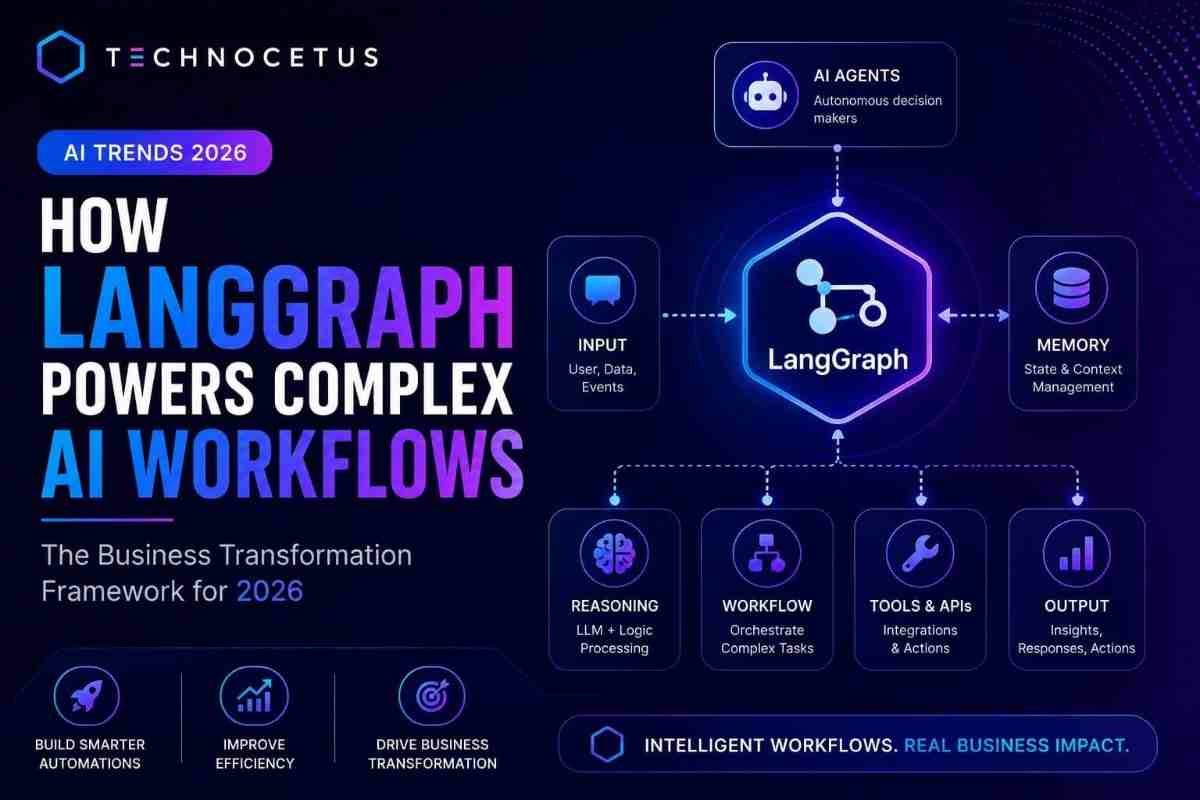
How LangGraph Powers Complex AI Workflows: The Framework Quietly Transforming Enterprise AI in 2026
Most AI projects fail not because the models aren't good enough — but because the plumbing is wrong.
A Fortune 500 company deploys a generative AI assistant. It answers questions brilliantly in demos. In production, it hallucinates on edge cases, loses context after three turns, can't hand off to another system, and has no way to recover gracefully when something breaks. Six months and seven figures later, the project gets quietly archived.
This is the AI deployment gap — and it's the most expensive problem in enterprise technology right now. The models are ready. The orchestration layer isn't.
LangGraph is changing that. Built by the team at LangChain, LangGraph is an open-source framework for building stateful, multi-agent AI workflows — the infrastructure layer that turns powerful but isolated AI models into coordinated, production-grade systems. For engineering teams and business leaders trying to move from AI experimentation to business transformation, understanding LangGraph isn't optional. It's foundational.
The Problem LangGraph Solves: Why Linear AI Chains Break Down
To understand why LangGraph matters, you first need to understand what it replaces.
Early AI automation frameworks — including LangChain's own original chain abstraction — were built around linear pipelines: Input → Step 1 → Step 2 → Output. For simple use cases (summarize this document, answer this FAQ), linear chains work fine.
But real-world enterprise workflows aren't linear. They branch. They loop. They fail and retry. They require human approval at certain steps. They involve multiple specialized agents — one researching, one writing, one reviewing, one executing — that need to share state and coordinate in real time.
A linear chain trying to handle this complexity is like trying to manage a construction project using a single to-do list. At some point, the list stops being useful and the project starts collapsing.
LangGraph introduces graph-based workflow architecture — where nodes represent agents or actions, and edges represent the conditions under which control passes between them. This seemingly simple shift unlocks an entirely new class of AI capability.
How LangGraph Works: The Core Architecture
Nodes, Edges, and State
LangGraph's mental model maps cleanly onto how complex work actually happens:
- Nodes are individual units of work — an LLM call, a tool invocation, a human-in-the-loop checkpoint, or a conditional router
- Edges define the flow of control — which node runs next, based on what the previous node returned
- State is a shared data structure that persists across the entire graph — every node can read from it and write to it, maintaining full context throughout the workflow
This state persistence is what solves the "three-turn memory loss" problem that plagues simpler implementations. The graph always knows where it's been, what it found, and what decisions were made — regardless of how many steps the workflow has taken.
Cycles and Conditional Logic
Unlike directed acyclic graphs (DAGs) used in traditional data pipelines, LangGraph explicitly supports cycles — a node can route back to a previous node based on conditions. This enables:
- Reflection loops: an agent reviews its own output, identifies weaknesses, and rewrites before proceeding
- Retry logic: if a tool call fails or returns unexpected data, the graph routes back to a planning node to try a different approach
- Iterative refinement: a research agent keeps searching until it has sufficient evidence to meet a defined confidence threshold
This is what separates LangGraph-powered systems from basic prompt chains — the ability to reason, check work, and course-correct autonomously.
Human-in-the-Loop as a First-Class Feature
One of LangGraph's most strategically important capabilities for enterprise deployment is native human-in-the-loop support. At any node, the graph can pause execution, surface its current state to a human reviewer, and wait for approval, correction, or additional input before proceeding.
For regulated industries — finance, healthcare, legal — this isn't a nice-to-have. It's the difference between a system that can be deployed and one that can't. LangGraph makes compliance-ready AI workflows achievable without custom engineering for every use case.
See our guide on building production-ready multi-agent systems with LangGraph and LangSmith →
LangGraph in Practice: Real-World Workflow Applications
Autonomous Research and Report Generation
One of the most mature LangGraph use cases is multi-step research workflows. A typical implementation involves:
- A planning agent that decomposes a research question into sub-queries
- Multiple search agents running in parallel, each pursuing a different angle
- A synthesis agent that combines findings, identifies gaps, and routes back to search if coverage is insufficient
- A writing agent that produces structured output in a specified format
- A review agent that checks factual claims, flags uncertainty, and requests human sign-off on sensitive assertions
What previously required a team of analysts working over days can be executed in minutes — with full auditability of every decision made along the way.
Code Generation and Quality Assurance Pipelines
Software engineering teams are using LangGraph to build AI automation pipelines that write, test, and debug code in coordinated loops:
- A code generation agent produces an initial implementation based on a specification
- A test execution agent runs the code against test suites and captures output
- A debugging agent analyzes failures and proposes fixes
- The loop continues until tests pass or the system escalates to a human developer
Teams using this pattern report significant reductions in time-to-PR for routine feature work — with engineers shifting from implementation to specification and review.
Customer Support Escalation Orchestration
In customer-facing deployments, LangGraph enables sophisticated triage and routing workflows that outperform both pure automation and pure human approaches:
- An intent classification agent categorizes the customer's issue
- Routine issues route to a resolution agent with access to order systems, knowledge bases, and refund tools
- Complex or high-value issues route to a context assembly agent that prepares a complete brief before handing to a human agent
- Post-resolution, a quality agent scores the interaction and flags coaching opportunities
The result: higher containment rates, faster resolution times, and human agents who only handle cases where their judgment genuinely adds value.
Financial Document Processing
Machine learning models embedded in LangGraph graphs are processing financial documents — loan applications, compliance reports, audit packages — with a level of nuance that simple extraction pipelines can't match:
- Documents are classified and routed to specialist extraction agents
- Extracted data is cross-validated against external sources and internal records
- Anomalies trigger investigation sub-graphs with configurable escalation paths
- Final outputs include confidence scores and audit trails that satisfy regulatory requirements
External resource: The LangChain State of AI Agents Report 2025 provides detailed benchmarking on agent framework adoption, failure modes, and production deployment patterns across 1,000+ engineering teams.
The Challenges: What to Get Right Before You Scale
State Management Complexity
The same state persistence that makes LangGraph powerful also makes it complex to reason about at scale. As graphs grow — more nodes, more conditional branches, more agents writing to shared state — debugging unexpected behavior becomes genuinely difficult. Teams underestimate this until they're in production.
Mitigation: Invest in observability from day one. LangSmith (LangChain's tracing platform) provides step-by-step visibility into graph execution — treat it as mandatory infrastructure, not an optional add-on.
Latency in Multi-Step Workflows
Complex graphs with many sequential LLM calls accumulate latency. A 10-node workflow where each LLM call takes 2 seconds has a minimum execution time of 20 seconds before any other overhead — unacceptable for synchronous user-facing applications.
Mitigation: Identify which nodes can run in parallel (LangGraph supports parallel execution natively) and which are on the critical path. Architect for async execution where the use case permits.
Cost Management
Multi-agent graphs make many more LLM calls than single-turn interactions. Without careful design — selecting the right model tier for each node, caching intermediate results, short-circuiting unnecessary steps — token costs can escalate rapidly.
Mitigation: Use large frontier models only for high-complexity reasoning nodes. Route simpler tasks (classification, extraction, formatting) to smaller, cheaper models within the same graph.
Ethical Guardrails in Autonomous Loops
When AI agents operate in cycles with minimal human oversight, the risk of compounding errors grows. A flawed assumption in a planning node propagates through the entire graph — and autonomous retry loops can amplify rather than correct the initial mistake.
Mitigation: Define explicit termination conditions and maximum iteration counts for every loop. Build dedicated safety check nodes that validate agent outputs against defined constraints before consequential actions are taken. In the future of work, autonomous AI systems need embedded ethics — not just guardrails bolted on afterward.
Opportunities: Why LangGraph Is a Strategic Differentiator
The organizations investing in LangGraph-based infrastructure today are building capabilities that are genuinely difficult to replicate:
- Workflow IP: the graph architectures your team designs for your specific business processes encode institutional knowledge that competitors cannot simply license
- Compounding automation: each workflow you build teaches your team how to build the next one faster — the learning curve is steep but the plateau is high
- Talent signal: engineers who understand agent orchestration are among the most sought-after in the industry; investing in this space attracts and retains them
- Regulatory readiness: organizations that build human-in-the-loop workflows from the start will adapt more easily to incoming AI regulation than those retrofitting oversight after the fact
Actionable Insights: Building With LangGraph
For Engineering Leaders:
- Start with one high-value, well-defined workflow — customer support triage, document processing, or internal research — rather than attempting to orchestrate your entire operations in one build
- Deploy LangSmith in parallel from day one — you cannot debug what you cannot observe; tracing is infrastructure, not tooling
- Define your state schema before writing any nodes — the shape of your shared state determines everything downstream; changes to it mid-build are expensive
For Business Leaders:
- Map your highest-cost knowledge workflows before evaluating LangGraph — the ROI case is strongest where multi-step reasoning, specialist handoffs, and compliance checkpoints currently require significant human time
- Budget for iteration, not just deployment — LangGraph workflows improve dramatically with production data and real failure cases; plan for a 90-day optimization cycle post-launch
- Engage your compliance and legal teams early — human-in-the-loop capabilities make regulated deployments achievable, but only if the approval workflows are designed with legal requirements in mind from the start
For Developers Getting Started:
- Build the LangGraph quickstart tutorial end-to-end before designing production systems — the conceptual shift from chains to graphs takes hands-on experience to internalize
- Design your first graph on paper — literally draw the nodes and edges before writing code; visual graph design surfaces logical gaps that code hides
- Start with
MemorySaverfor state persistence in development, then migrate to a production-grade checkpointer (PostgreSQL, Redis) before shipping
The Bottom Line
LangGraph represents the maturation of enterprise AI automation — the moment the industry moved from building impressive demos to building reliable systems. The framework's ability to orchestrate stateful, cyclical, multi-agent workflows with native human oversight addresses the precise failure modes that have made AI deployment difficult at scale.
For organizations ready to move from AI experimentation to genuine business transformation, LangGraph isn't just a developer tool. It's strategic infrastructure — the layer that turns the enormous investment in generative AI models into compounding operational advantage.
The AI plumbing problem is solved. The only question now is who builds on it first.
Keywords targeted: LangGraph AI workflows, AI automation orchestration, generative AI multi-agent, machine learning business transformation, future of work