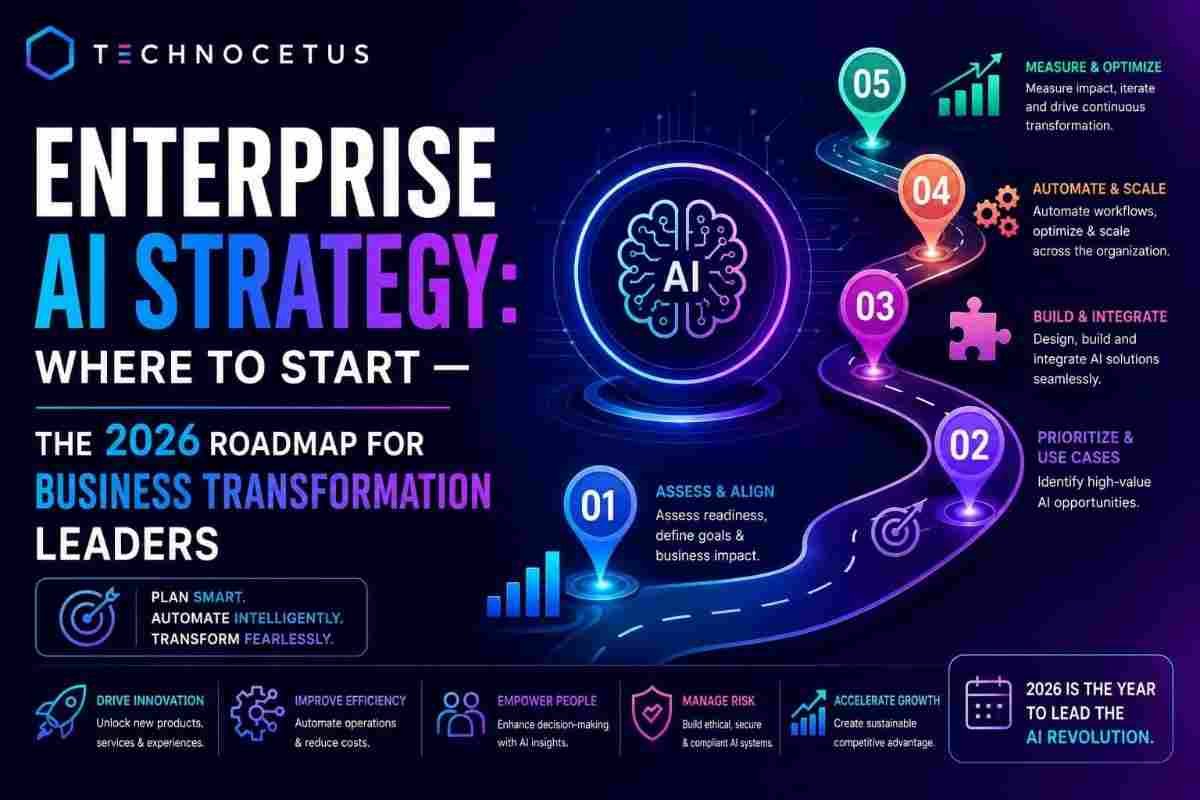
Enterprise AI Strategy: Where to Start — The 2026 Roadmap Every Business Leader Needs
Ask ten enterprise executives what their AI strategy is and you'll get ten different answers. Ask their teams what's actually being built, and you'll get thirty more. Somewhere between the boardroom vision and the production environment, most enterprise AI strategies dissolve into a collection of disconnected pilots, vendor relationships, and proof-of-concepts that never quite graduate to business impact.
The uncomfortable diagnosis: most organizations don't have an AI strategy. They have AI activity — and they're calling it a strategy.
The difference matters enormously. AI activity is reactive — chasing use cases, responding to vendor pitches, green-lighting experiments because competitors are doing something similar. AI strategy is intentional — starting from business outcomes, identifying where artificial intelligence creates durable advantage, and building the organizational capabilities to sustain it over time.
In 2026, with AI automation tools more powerful and accessible than ever, the gap between organizations with genuine AI strategy and those with AI activity is becoming a structural competitive divide. This post gives you the framework to land on the right side of it.
The Strategic Starting Point: Outcomes Before Technology
The single most important principle in enterprise AI strategy is deceptively simple: start with the business outcome, not the technology.
This sounds obvious. It is almost universally ignored.
The typical enterprise AI journey begins with a technology conversation — "we need to deploy a large language model," "our competitors are using generative AI," "the board wants an AI roadmap by Q3." These are technology-first framings, and they produce technology-first strategies that optimize for deployment metrics rather than business results.
A strategy built backwards from business outcomes asks different questions:
- Where are our highest-cost operational bottlenecks?
- Where does information latency cause us to make slower or worse decisions than we should?
- Where are customer experiences degrading because we can't personalize or respond at the speed they expect?
- Where is talent scarcity limiting our ability to grow?
The answers to these questions — not the technology landscape — are where enterprise AI strategy begins. The technology choices follow from the problems worth solving, not the other way around.
The Four Strategic Domains of Enterprise AI
Once you've grounded your strategy in business outcomes, the question becomes: which categories of AI application create the most durable value in an enterprise context?
1. Operational Intelligence: AI Automation of Knowledge Work
The most immediate and measurable ROI in enterprise AI comes from applying AI automation to high-volume, high-complexity knowledge work — the category of tasks that previously required expensive human expertise to execute repeatedly.
Examples already delivering enterprise ROI:
- Contract review and extraction: legal teams using ML-powered contract intelligence to review NDAs, MSAs, and vendor agreements in minutes rather than hours
- Financial close automation: AI agents that reconcile accounts, flag anomalies, and generate variance explanations — compressing month-end close from weeks to days
- Technical documentation: generative AI that synthesizes internal wikis, engineering specs, and product documentation into queryable knowledge bases accessible to every employee
The strategic insight here is that operational intelligence AI creates multiplier effects on existing talent — each high-skilled employee can do more, cover more, and decide faster when supported by AI that handles research, synthesis, and routine execution.
2. Customer Intelligence: Personalization at Scale
The second strategic domain is using machine learning to understand and respond to customers at a level of granularity that was economically impossible before AI.
Enterprise applications include:
- Real-time churn prediction with proactive intervention workflows
- Next-best-action recommendation engines across sales, support, and marketing
- Dynamic pricing and offer optimization based on individual customer signals
- AI-powered customer service that resolves tier-1 and tier-2 issues without human intervention while escalating complex cases with full context
Organizations that build customer intelligence capabilities compound their advantage over time — every customer interaction generates data that improves the model, which improves the experience, which generates more data.
3. Decision Intelligence: AI-Augmented Leadership
The third domain — and the most strategically significant for senior leaders — is using AI to improve the quality and speed of decisions at every level of the organization.
This isn't about replacing human judgment. It's about augmenting it with better information, faster analysis, and explicit surfacing of risks and options that manual analysis would miss or take too long to identify.
Enterprise implementations include demand forecasting, risk modeling, scenario planning, and operational anomaly detection — all areas where the sheer volume of relevant data exceeds what human analysis can process in the time available for decision-making.
4. Product Intelligence: AI-Native Products and Services
The fourth domain is the most transformational over a multi-year horizon: embedding AI capabilities into the products and services you sell, not just the operations that deliver them.
Organizations that build AI-native products — where the AI capability is core to the value proposition, not a feature bolted on — are creating competitive positions that are genuinely difficult to replicate. This is where business transformation through AI moves from efficiency play to market position play.
See our guide on building an AI product roadmap alongside your operational AI strategy →
Emerging Trends Shaping Enterprise AI Strategy in 2026
Agentic AI Moves From Pilot to Production
The most significant architectural shift in enterprise AI right now is the move from single-turn AI interactions to agentic workflows — AI systems that plan, execute multi-step tasks, use tools, and operate with meaningful autonomy over extended time periods.
Organizations that piloted agentic systems in 2024 and 2025 are now scaling them into production. The enterprises that haven't started piloting yet are falling behind a curve that is becoming harder to climb.
The Sovereign AI Imperative
Data sovereignty, regulatory requirements, and competitive sensitivity are driving enterprises toward private AI deployments — models running on proprietary infrastructure, fine-tuned on internal data, isolated from external training pipelines.
For industries with sensitive data — financial services, healthcare, defense, legal — sovereign AI isn't a preference; it's increasingly a regulatory requirement and a board-level risk management priority.
Small Models, Big Impact
The enterprise AI community's obsession with frontier model scale is giving way to a more nuanced understanding: smaller, purpose-built models fine-tuned on domain-specific data frequently outperform massive general models on enterprise tasks — at a fraction of the cost and latency.
Strategic AI organizations are building portfolios of specialized models rather than betting everything on a single frontier provider.
The Real-World Proof: Enterprise AI Strategies That Delivered
JPMorgan Chase's AI strategy, centered on the firm's internally developed LLM platform, now supports over 200 distinct AI applications across trading, risk, compliance, and customer service. The firm's AI investment has reportedly generated billions in value — not from a single moonshot, but from disciplined application of AI across high-value business processes with rigorous outcome measurement.
Siemens' AI-powered predictive maintenance platform — deployed across manufacturing clients globally — uses ML models trained on sensor data to predict equipment failures before they occur. Clients report 25–30% reductions in unplanned downtime, translating directly to production yield improvement.
A global professional services firm (reported in Deloitte's 2025 AI Adoption Survey) deployed generative AI across its research and proposal functions, reducing proposal development time by 60% while improving win rates through better personalization. The project succeeded because it started from a specific business outcome — reduce proposal cost, improve win rate — and selected technology to serve that outcome.
External resource: The Stanford HAI AI Index Report 2025 provides the most rigorous annual benchmarking of enterprise AI adoption, investment trends, and productivity impact across global industries.
Challenges: Ethics, Bias, and Regulation in Enterprise AI
No enterprise AI strategy survives contact with reality without confronting three unavoidable challenges.
Bias at Organizational Scale
Machine learning models deployed in enterprise contexts — hiring tools, credit decisioning, performance management, customer routing — can encode and amplify demographic bias at a scale that creates both ethical harm and significant legal liability. The EU AI Act, EEOC guidance on algorithmic hiring tools, and emerging US state-level AI regulations are all moving toward mandatory bias auditing for high-stakes AI applications.
Enterprise AI strategy must include algorithmic audit schedules as standard practice — not a response to incidents, but a proactive governance commitment.
The Accountability Gap
When an AI system makes a consequential decision — a loan denial, a medical flag, a contract recommendation — the accountability structures of most organizations are unprepared. Who is responsible when an AI-generated output causes harm? The model vendor? The team that deployed it? The executive who approved the budget?
Answering this question — clearly, in writing, before deployment — is not a legal formality. It's the foundational governance act of responsible enterprise AI.
Regulatory Velocity
The pace of AI regulation is accelerating faster than most enterprise legal and compliance functions can track. The EU AI Act is fully in force. US federal agencies are issuing AI guidance across financial services, healthcare, and employment. Countries from India to Brazil to Canada are advancing their own frameworks.
Strategic advantage goes to organizations that treat regulatory compliance as a design requirement, not a deployment checklist. Build audit trails, human oversight mechanisms, and documentation standards in from the start.
Actionable Insights: Building Your Enterprise AI Strategy
For C-Suite and Board Leaders:
- Commission a Value Opportunity Audit before any additional AI investment — map your top 10 operational cost drivers and decision bottlenecks, then assess which are most addressable by AI; this is your prioritized portfolio
- Appoint a Chief AI Officer or equivalent with cross-functional authority — AI strategy that lives only in IT or only in product will fail to drive enterprise-wide transformation
- Set a 3-year AI capability roadmap with annual milestones — not a list of use cases, but a capability development plan: what data infrastructure, talent, governance, and organizational practices you will build by when
For Strategy and Operations Leaders:
- Build your AI use case portfolio with explicit ROI hypotheses — every initiative should have a defined baseline, a target metric, and a measurement mechanism before it receives resources
- Identify your two or three highest-value AI opportunities and resource them properly rather than spreading investment across twenty underfunded pilots that produce no production-grade outcomes
- Create a Center of Excellence that owns AI deployment standards, vendor evaluation, and knowledge sharing — the overhead is real, the compounding value is larger
For Technology Leaders:
- Invest in data infrastructure before model selection — the quality of your data architecture determines the ceiling of every AI application built on top of it; no model overcomes poor data
- Build model monitoring and governance tooling as foundational infrastructure, not an afterthought — observability, drift detection, and audit logging should be in place before the first production deployment
- Evaluate build vs. buy vs. partner with explicit criteria — fine-tuned proprietary models, API-accessed frontier models, and vendor solutions have very different cost, control, and capability profiles; the right answer varies by use case
The Bottom Line
Enterprise AI strategy in 2026 is not about being first to deploy — it's about being right in what you build and disciplined in how you build it. The organizations generating real business transformation from AI are not the ones with the largest AI budgets or the most public announcements. They're the ones that started with clear business outcomes, built the data and governance foundations before scaling, brought their people along, and invested in measurement from day one.
The technology is ready. The market pressure is real. The future of work will be defined by how well organizations translate AI potential into operational reality.
Where you start matters. Start with the outcome. Build toward it deliberately. And measure everything.
Keywords targeted: enterprise AI strategy 2026, AI automation business transformation, generative AI implementation roadmap, machine learning enterprise adoption, future of work AI strategy