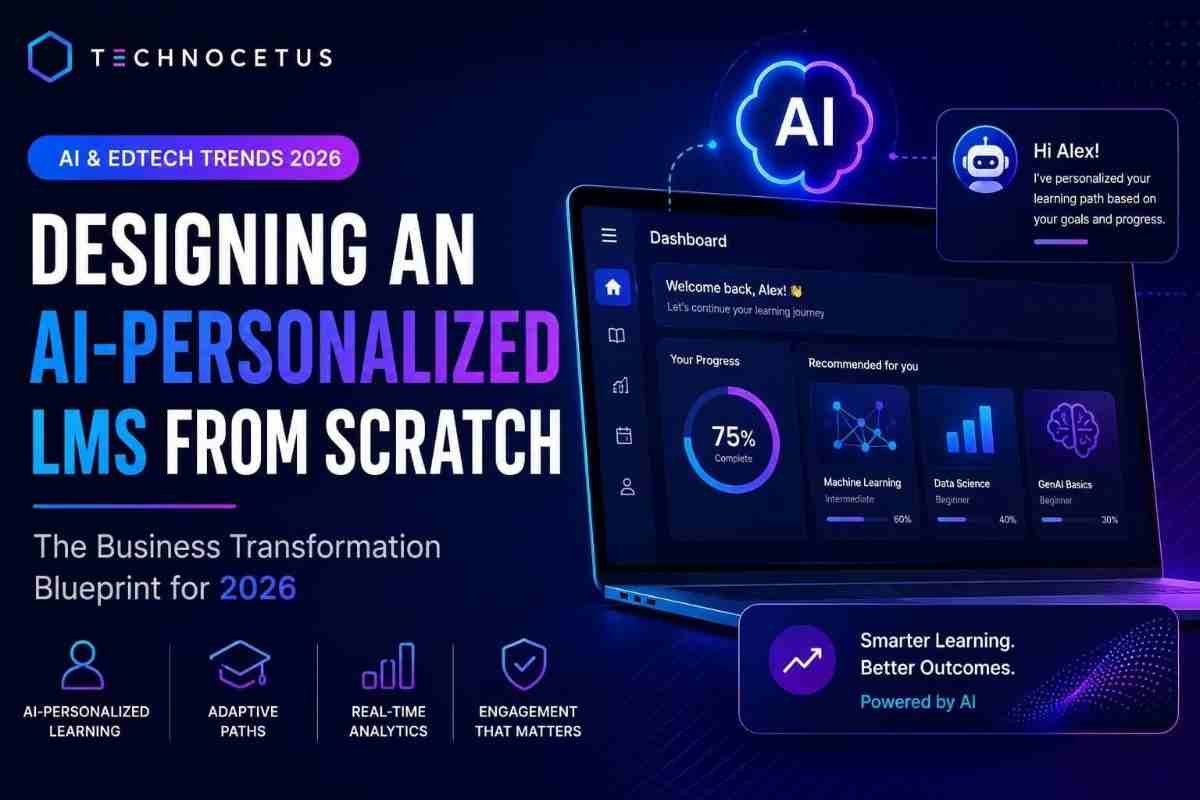
Designing an AI-Personalized LMS from Scratch: The Blueprint Redefining Workforce Learning in 2026
Here's a number that should make every L&D leader uncomfortable: organizations waste an estimated $13.5 million per 1,000 employees annually on ineffective training — content that's too generic, too slow, too disconnected from how people actually work, and forgotten within a week of completion.
The traditional Learning Management System — the one with the 47-slide compliance module, the mandatory quiz with three attempts, and the completion certificate that means nothing — is not a learning tool. It's a liability management tool dressed up as one.
The future of workforce development looks radically different. It's adaptive. It's contextual. It knows that your top sales rep needs negotiation coaching and your junior engineer needs systems design fundamentals — and it delivers precisely that, at exactly the right moment, in exactly the right format. That future is being built right now by organizations willing to design their learning infrastructure from the ground up with AI automation at the core.
This is the blueprint.
Why Traditional LMS Platforms Are Failing the Modern Workforce
Before designing the solution, it's worth being precise about the problem.
The average corporate LMS was architected in an era of classroom-to-digital content migration. Its core assumption: learning is a scheduled event, content is one-size-fits-all, and completion equals competency. None of these assumptions survive contact with how knowledge workers actually develop skills in 2026.
The data is damning:
- Only 12% of employees apply skills learned in training back to their jobs, according to research from the Association for Talent Development
- 58% of employees say they would prefer to learn at their own pace rather than on a schedule imposed by their organization
- The average attention span for e-learning modules peaks at 9 minutes — yet most compliance courses run 45 to 90 minutes
The result: billions of dollars in training investment producing measurable behavioral change in a small minority of learners. The problem isn't the learners. It's the design philosophy.
An AI-personalized LMS built from scratch rejects every one of these assumptions and replaces them with a learner-intelligence model that adapts continuously to individual needs, context, and pace.
The Architecture: What an AI-Personalized LMS Actually Looks Like
Layer 1: The Learner Intelligence Engine
The foundational layer of any AI-personalized LMS is a machine learning model that builds and continuously refines a dynamic profile of each learner. This goes far beyond tracking course completions.
A sophisticated learner intelligence engine captures:
- Knowledge state: what the learner demonstrably knows vs. what they think they know (these are frequently different)
- Learning velocity: how quickly the learner masters new concepts in different domains
- Preferred modalities: whether they engage more with video, text, interactive simulations, or peer discussion
- Optimal session timing: when in their day they demonstrate highest retention — patterns the AI identifies from engagement and assessment data over time
- Skill gaps vs. role requirements: mapped against current job responsibilities and career trajectory targets
This profile isn't static. It updates with every interaction — a correct answer on a spaced repetition prompt, a video paused and rewound three times, an assessment score, a manager's performance review input. The model gets more accurate the more it's used.
Layer 2: Adaptive Content Delivery
With a dynamic learner profile established, the system's content layer can do something traditional LMS platforms fundamentally cannot: serve the right content to the right person at the right time.
This layer includes:
- Intelligent content sequencing: pathways that branch based on demonstrated mastery rather than a fixed curriculum schedule
- Difficulty calibration: assessment items and content complexity that adjust in real time — neither boring the fast learner nor overwhelming the one who needs more time
- Contextual microlearning: 3-to-5-minute modules surfaced at the point of need (before a client call, after a performance review, during onboarding to a new tool) rather than scheduled weeks in advance
- Multi-format delivery: the same concept delivered as a video summary, a text deep-dive, a worked example, or a practice simulation — based on what the learner profile indicates will drive retention
Layer 3: Generative AI Content Creation
One of the most transformative shifts enabled by generative AI in LMS design is the ability to create and customize content at scale without proportional increases in instructional design resources.
Modern AI-personalized LMS platforms use generative models to:
- Synthesize proprietary content — transforming internal wikis, SOPs, product documentation, and SME interviews into structured learning modules automatically
- Generate assessment variants — producing novel quiz questions and scenario-based assessments that test genuine understanding rather than pattern recognition from repeated exposure to the same items
- Personalize examples and analogies — adapting case studies to be relevant to the learner's industry, role, and experience level (a financial services example for the banking team member; a retail scenario for the store operations manager)
- Create conversational practice simulations — AI roleplay partners that simulate client objections, difficult employee conversations, or technical interviews at adjustable difficulty
See our guide on building generative AI content pipelines for enterprise learning programs →
Layer 4: Analytics and Organizational Intelligence
Individual learner data, aggregated and analyzed at the organizational level, transforms the LMS from a training delivery tool into a strategic workforce intelligence platform.
This layer surfaces:
- Skill gap maps by team, function, and geography — giving L&D and HR leaders visibility into where capability risk is accumulating before it affects performance
- Learning ROI modeling — connecting training completion and skill development data to downstream performance metrics, retention rates, and promotion velocity
- Predictive attrition signals — research consistently links engagement in learning to retention; the model flags employees whose learning disengagement may predict departure risk
- Curriculum effectiveness scoring — identifying which content actually drives skill application versus what learners complete but don't use
External resource: The Josh Bersin Company's AI in Learning & Development Report 2025 provides the most comprehensive benchmarking available on AI-powered LMS ROI and enterprise adoption patterns.
Real-World Applications: Organizations Building It Right
Walmart's Academy Platform uses adaptive learning paths to train over 1.5 million associates — tailoring content by role, store format, and individual performance data. The system reduced time-to-competency for new department managers by 30% while improving assessment scores and on-the-job performance ratings simultaneously.
Duolingo for Business — an instructive model even outside language learning — demonstrates the power of spaced repetition, adaptive difficulty, and streak-based engagement mechanics driven by ML. Enterprise clients report completion rates 4x higher than traditional e-learning programs, with measurable skill retention at 90-day follow-up.
A global financial services firm (reported in Deloitte's 2025 Human Capital Trends Report) deployed a generative AI-powered LMS that automatically creates compliance training modules from regulatory updates within 48 hours of publication — a process that previously required 6 to 8 weeks of instructional design work. Audit-ready documentation is generated automatically, reducing compliance risk while cutting L&D operational costs by 40%.
Challenges: Ethics, Bias, and Governance in AI-Powered Learning
Designing an AI-personalized LMS from scratch means designing its risks in from scratch too. Several challenges demand deliberate attention.
Algorithmic Bias in Personalization
If the machine learning models that power your learner intelligence engine are trained on historical performance data, they may encode existing inequities. A model that routes high-potential learners toward leadership development pathways based on past promotion patterns may systematically underserve employees from underrepresented groups — not because of explicit bias, but because historical data reflects historical inequity.
Regular bias audits of recommendation and routing models — comparing outcomes across demographic segments — are not optional in ethical AI-personalized LMS design.
Surveillance vs. Support
The same behavioral data that enables deep personalization can feel like surveillance to employees if not handled transparently. Organizations must clearly communicate what data is collected, how it's used, and crucially — that it is used to support the learner, not evaluate them for disciplinary purposes. Consent architecture and clear data governance policies build the trust that makes learners willing to engage authentically with the system.
The Deskilling Risk
Highly personalized systems that always route learners toward their comfort zone can reinforce existing knowledge patterns rather than building new capability. Effective AI-personalized LMS design includes deliberate challenge injection — pushing learners into productive discomfort at calibrated intervals — to drive genuine growth rather than optimized comfort.
Data Privacy and Compliance
Employee learning data is sensitive personal data under GDPR, CCPA, and emerging workplace AI regulations. Data minimization, purpose limitation, and clear retention policies must be built into the architecture before deployment — retrofitting compliance onto a live system is exponentially more expensive and risky.
The Opportunity: Why Now Is the Right Moment to Build
Three forces have converged to make 2026 the ideal moment to design an AI-personalized LMS from scratch rather than continuing to customize legacy platforms:
- Generative AI capability has reached the point where automated content creation and conversational simulation are genuinely effective — no longer impressive demos, but production-ready tools
- API-first infrastructure (LRS standards, xAPI, modern identity providers) makes integration with HR systems, performance platforms, and communication tools faster and cheaper than ever
- Workforce demand for personalized, self-directed learning has never been higher — organizations that offer it gain measurable advantages in talent attraction and retention
The organizations that invest in intelligent learning infrastructure now will build workforce capability advantages that compound over years. Those that continue patching legacy LMS platforms will find themselves in an increasingly expensive catch-up position.
Actionable Insights: Your AI-Personalized LMS Roadmap
For L&D and HR Leaders:
- Audit your current LMS for completion vs. application — if you can only measure whether employees finished a course, not whether they applied it, your data architecture is the first problem to solve
- Start with one high-stakes learning use case — new manager development, sales onboarding, or compliance training — rather than attempting to personalize your entire curriculum in one build
- Involve learners in design — run discovery sessions with target audiences before building; the assumptions your L&D team holds about how employees want to learn are frequently wrong
For Technology and Product Teams:
- Choose an xAPI-compliant data layer from day one — this standard enables the behavioral data capture that makes genuine personalization possible; without it, you're flying blind
- Build your learner profile schema before selecting content tools — the data model is the product; content delivery tools are interchangeable, learner intelligence is not
- Integrate with performance management systems early — connecting learning data to performance outcomes is what transforms L&D from a cost center to a strategic function
For Business Leaders:
- Reframe the LMS as workforce intelligence infrastructure, not a training delivery tool — the strategic case is talent retention, capability velocity, and organizational agility, not compliance coverage
- Set 18-month capability targets before launching — define the specific skills the organization needs to develop and measure progress against them, not just training hours completed
- Allocate budget for iteration — the first version of your AI-personalized LMS will be significantly less capable than version three; plan for a continuous improvement cycle, not a one-time deployment
The Bottom Line
Designing an AI-personalized LMS from scratch is one of the highest-leverage infrastructure investments an organization can make in 2026. It converts one of the most universally ineffective categories of enterprise spending — generic, scheduled, completion-tracked training — into a genuine engine of capability development, talent retention, and organizational adaptability.
The technology is ready. The workforce expectation is set. The competitive pressure from organizations that are already building is real.
The $13.5 million per thousand employees in wasted training spend is a cost waiting to be recovered. The question is whether your organization recovers it — or your competitors do.
Keywords targeted: AI-personalized LMS, machine learning learning management system, generative AI corporate training, AI automation workforce development, future of work