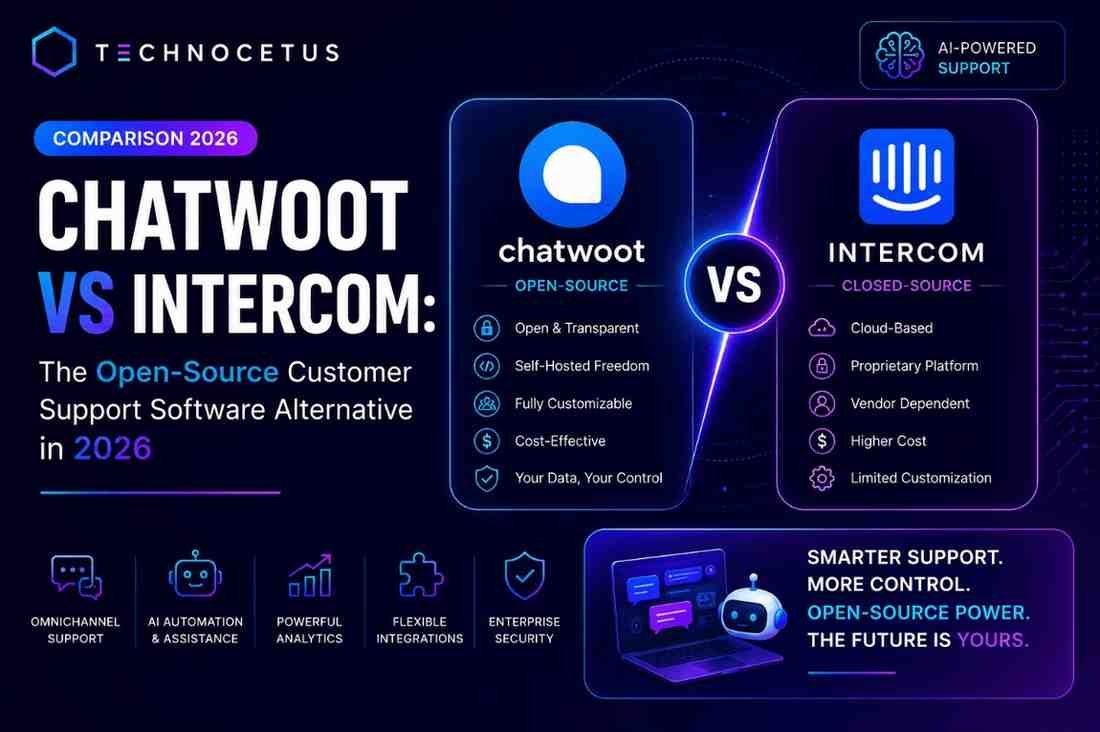
Chatwoot vs Intercom: The Open-Source Customer Support Software Alternative in 2026
Meta description: Chatwoot vs Intercom compared for 2026 — pricing, features, AI automation, and data ownership. See why teams are switching to open-source support.
Introduction: The Invoice That Started the Search
It usually starts the same way. A support team logs into their billing dashboard, expecting the usual line item — and finds it's ballooned. Seat fees crept up, a few AI resolutions got tacked on at a dollar apiece, and suddenly a five-person team is paying four figures a month just to answer customer emails. That sticker shock is exactly what's driving a steady migration toward open-source customer support software, and one name keeps coming up: Chatwoot.
Chatwoot has spent the last several years positioning itself as the open-source answer to Intercom — same core job (unifying chat, email, and social messages into one inbox), radically different business model. In 2026, with AI usage fees stacking on top of per-seat pricing across the proprietary support-tool market, that difference matters more than ever.
What Is Chatwoot?
Chatwoot is an open-source, self-hostable customer engagement platform that brings live chat, email, and social channels into a single shared inbox. <cite index="19-1">Founded in 2017 and backed by Y Combinator and Goat Capital, the project has grown into a mature codebase with 320 contributors, nearly 5,900 commits, and 137 releases, with version 4.11.2 shipping in March 2026</cite>. <cite index="12-1">It's now the de facto open-source Intercom alternative, with over 27,000 GitHub stars and production deployments across thousands of companies</cite>.
Released under the permissive MIT license, Chatwoot can be self-hosted for free or run on Chatwoot's managed cloud — giving teams a choice between full control and zero-maintenance convenience.
Core features at a glance
- Omnichannel inbox — <cite index="20-1">live chat, email, WhatsApp, Telegram, Facebook Messenger, and Instagram unified in one agent view</cite>
- Canned responses and macros for repetitive replies
- A built-in AI assistant called Captain, plus support for third-party chatbot integrations
- Reporting and SLAs on paid tiers
- An embeddable website widget with a customizable UI
- Self-hosting via Docker Compose, or a fully managed cloud option
Chatwoot vs Intercom: How the Pricing Actually Compares
This is where the two platforms diverge most sharply — and where most buying decisions get made.
<cite index="15-1">Intercom's advertised seat pricing rarely reflects the real bill; teams commonly see costs run 60–80% above the sticker price once AI usage and add-ons are included</cite>. <cite index="15-1">A five-person team on Intercom's Advanced plan with moderate AI usage can land anywhere from $800 to $1,200 a month</cite>. The biggest driver is usage-based AI billing: <cite index="15-1">Intercom's Fin AI Agent charges $0.99 per resolved conversation, which adds roughly $1,980 a month for a team resolving 2,000 tickets — before any base seat cost</cite>.
Chatwoot's model looks very different:
- Community Edition (self-hosted) — <cite index="15-1">free under the MIT license, with full source code access and no agent limits</cite>
- Chatwoot Cloud Startups — <cite index="15-1">around $19 per agent per month, with all channels included</cite>
- Chatwoot Cloud Business — <cite index="15-1">roughly $39 per agent per month, adding full reporting, teams, and SLAs</cite>
- Chatwoot Cloud Enterprise — <cite index="15-1">about $99 per agent per month, adding SSO, audit logs, and white-labeling</cite>
Crucially, <cite index="15-1">channels like WhatsApp, Telegram, email, and Instagram come included in the plan price on Chatwoot, with no per-session fees layered on top</cite>. For a five-person team, <cite index="14-1">the real-world cost gap plays out as roughly $10–40 a month for self-hosted Chatwoot versus $195–695 a month for Intercom</cite> — before AI usage fees are even factored in.
The analogy: renting vs. owning
Think of Intercom as a full-service serviced apartment — everything's handled for you, but every extra towel and late checkout adds to the bill. Chatwoot is more like buying a condo: a bigger upfront commitment of technical effort, but no landlord metering your AI conversations by the resolution.
Where Intercom Still Wins
Open source isn't a free lunch, and a fair comparison has to say so.
- Polish and turnkey AI: <cite index="14-1">Intercom's Fin AI bot is considered a strong, ready-to-use AI resolution engine</cite>, whereas <cite index="16-1">Chatwoot has historically relied more on third-party chatbot integrations rather than a fully native equivalent</cite> — though its own Captain assistant has been closing that gap.
- Zero DevOps overhead: Self-hosting Chatwoot means someone on your team owns updates, backups, and uptime, or you pay a managed-hosting provider to do it.
- Enterprise scale: <cite index="16-1">Intercom is built for large enterprises handling very high support volumes</cite>, and its ecosystem of integrations and sales tooling is more mature.
- Product tours and engagement extras: Intercom's roots in in-app messaging give it deeper product-led-growth tooling (tours, NPS surveys, campaigns) than Chatwoot ships out of the box.
Data Ownership and the "Future of Work" Argument
Beyond price, the sharpest dividing line is data control. With Intercom, <cite index="14-1">customer data lives on Intercom's own servers</cite>. With self-hosted Chatwoot, it lives wherever you decide to run it — your own cloud account, on-prem, or in a specific jurisdiction for compliance reasons.
That distinction is becoming more than a technical footnote. As business transformation increasingly runs through AI-assisted workflows, more support teams want visibility into exactly what data trains or feeds their AI assistant, and where conversation logs are stored. Self-hosting doesn't just save money — it gives compliance and security teams a much shorter answer to "where does our customer data go?"
For teams evaluating automation across their whole support stack, see our guide on RPA tools for where rules-based automation still beats AI agents.
Who Should Actually Switch?
Not every team benefits equally from moving off Intercom. A few patterns show up consistently:
Good fit for Chatwoot:
- Bootstrapped or early-stage startups watching burn closely
- Teams with in-house technical capacity (or budget for managed hosting)
- Organizations with strict data residency or compliance requirements
- High-ticket-volume teams getting squeezed by per-resolution AI fees
Better fit for Intercom:
- Large enterprises that want a fully managed, polished, all-in-one platform
- Teams that lean heavily on in-app product engagement (tours, surveys, campaigns)
- Organizations that would rather pay a premium than manage any infrastructure
Actionable Next Steps
- Audit your current bill line by line. Separate seat costs from AI usage fees — the usage line is usually where the real savings live.
- Pilot Chatwoot on a single channel first. Move email or live chat before migrating your full omnichannel setup.
- Decide your hosting model up front. Self-host if you have the technical bandwidth; use managed Chatwoot Cloud if you want the cost savings without the DevOps burden.
- Map your compliance requirements before migrating. If data residency matters, confirm your hosting region before committing.
- Run both platforms in parallel for two weeks before fully cutting over, so agents can compare workflows with real tickets.
Final Thought
Chatwoot's rise isn't really an argument that open source always beats proprietary software — it's a reminder that in customer support, where AI usage fees now compound per-seat pricing, the "free and flexible" option has become genuinely competitive on features, not just cost. For teams willing to own a bit more infrastructure, Chatwoot offers a credible, well-maintained path off the Intercom invoice.
For an independent look at the open-source project's health and release cadence, see Chatwoot's public repository on GitHub.
SEO Metadata
Suggested SEO Title: Chatwoot vs Intercom: Open-Source Customer Support Alternative (2026)
Meta Description: Chatwoot vs Intercom compared for 2026 — pricing, features, AI automation, and data ownership. See why teams are switching to open-source support.
Recommended Keywords:
- Chatwoot vs Intercom
- open-source customer support software
- self-hosted live chat
- AI automation (support/helpdesk)
- customer engagement platform