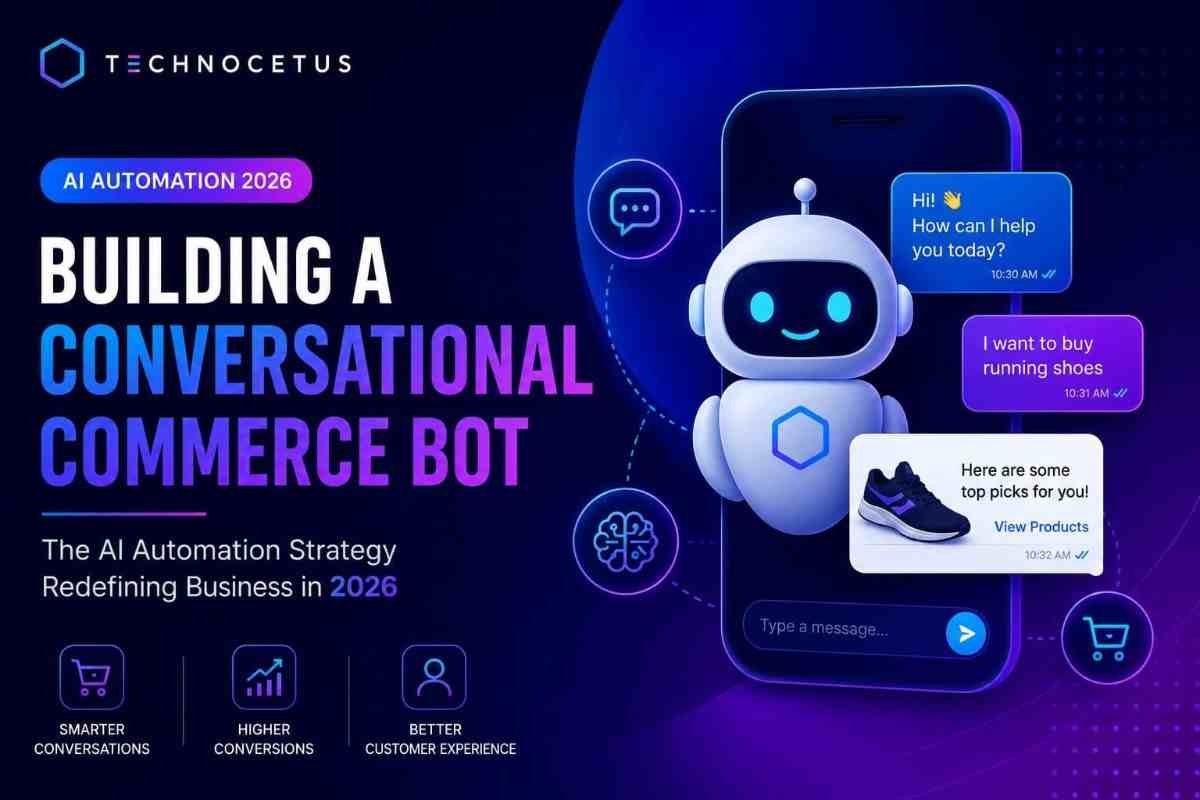
Building a Conversational Commerce Bot: The AI Automation Strategy Every Business Needs in 2026
What if your best salesperson never slept, remembered every customer's preferences, and closed deals across 14 languages simultaneously? That's not a hiring fantasy — that's a well-built conversational commerce bot, and in 2026, it's becoming as essential to business infrastructure as a website once was.
We've entered an era where customers don't just tolerate AI-powered conversations — they prefer them. According to Salesforce's State of the Connected Customer report, over 61% of consumers now say they'd rather resolve a purchase question via intelligent chat than wait on hold or scroll through FAQs. The businesses winning today aren't the ones with the biggest teams — they're the ones that have turned AI automation into a revenue-generating conversation.
This post breaks down what conversational commerce bots actually are, how to build one that works, where the industry is heading, and what every business leader needs to know to move forward confidently.
What Is a Conversational Commerce Bot — And Why Now?
A conversational commerce bot is an AI-powered interface — typically deployed via website chat, WhatsApp, Instagram DMs, or voice assistants — that guides customers through discovery, consideration, and purchase entirely through natural dialogue.
Unlike the rule-based chatbots of five years ago (the ones that sent you in loops asking you to "press 1 for billing"), modern bots are built on generative AI and large language models (LLMs). They understand intent, handle ambiguity, personalize recommendations in real time, and hand off to human agents — with full context — exactly when needed.
The timing matters because three forces have converged simultaneously:
- LLM capability has crossed the threshold where AI conversations feel genuinely helpful, not frustrating
- Consumer messaging behavior has shifted — people spend more time in chat interfaces than on web browsers
- Business pressure to reduce support costs while increasing customer satisfaction has never been higher
The result: conversational commerce is no longer a nice-to-have. It's a competitive moat.
The Architecture: What Makes a Commerce Bot Actually Work
Foundation Layer: Choosing Your AI Engine
Not all bots are created equal. The foundation of any effective conversational commerce system is the underlying machine learning model. Your options broadly fall into three tiers:
- Pre-built platforms (Intercom Fin, Drift, Tidio AI) — fastest to deploy, limited customization
- Composable frameworks (built on OpenAI, Anthropic, or Google APIs) — flexible, requires technical investment
- Fine-tuned proprietary models — highest performance for specialized use cases, highest cost and complexity
For most mid-market businesses, composable frameworks offer the best balance of capability and control. You get the power of frontier models with the ability to tailor behavior to your brand voice and product catalog.
The Intelligence Stack
A high-performing conversational commerce bot typically integrates:
- Retrieval-Augmented Generation (RAG) — grounds the AI in your actual product data, pricing, and policies rather than hallucinating answers
- User context memory — maintains purchase history, preferences, and prior conversations across sessions
- Tool use / function calling — allows the bot to check live inventory, apply discount codes, initiate returns, or query a CRM in real time
- Sentiment detection — escalates to human agents when frustration is detected, preserving the customer relationship
See our guide on choosing between RAG and fine-tuning for enterprise AI applications →
Emerging Trends Shaping Conversational Commerce in 2026
Trend 1: From Reactive to Proactive Commerce
Early bots waited for customers to ask questions. The new generation reaches out first — at precisely the right moment. Behavioral triggers (time on page, cart abandonment, return visit) activate proactive AI outreach: "Still thinking about those running shoes? Here's what other customers with similar preferences chose."
This shift from reactive to proactive is where AI automation begins to function like a high-performing sales rep, not just a support tool.
Trend 2: Voice-First Commerce Entering the Mainstream
Text-based bots are being augmented — and in some verticals, replaced — by voice-native interfaces. Amazon Alexa integrations, in-car AI assistants, and phone-based voice bots are creating entirely new purchase pathways. For brands in automotive, FMCG, and hospitality, voice-first conversational commerce is already generating measurable revenue.
Trend 3: Multimodal Conversations
Customers now expect to share an image ("Do you have anything like this?"), receive a video response, or scan a product in-store and continue the conversation on their phone. Generative AI models that process text, image, and audio simultaneously are enabling these multimodal flows — and the brands that deploy them are seeing significantly higher engagement and conversion rates.
Trend 4: Agentic Commerce Bots
The most advanced systems in 2026 aren't just conversational — they're agentic. Rather than answering questions, they complete entire journeys: researching options, comparing specifications, checking compatibility with past purchases, placing orders, and confirming delivery — all within a single conversation thread.
This is the future of work for commerce teams: human agents focusing on complex relationships and escalations while AI handles the full-funnel execution at scale.
Real-World Case Studies: Conversational AI Delivering Results
Sephora's Virtual Artist Bot — deployed across web and messaging platforms — combines product recommendations, AR try-on, and transactional capability in one conversation. The brand reported a 11% higher conversion rate from bot-assisted sessions versus traditional browse-and-checkout flows.
KLM Royal Dutch Airlines integrated a WhatsApp-based commerce bot that handles booking modifications, seat upgrades, and ancillary purchases. During peak travel periods, the bot resolves over 60% of customer requests without human involvement — reducing cost per interaction by an estimated 40%.
A mid-size DTC skincare brand (confidential client, reported by Gartner 2025) deployed a personalized consultation bot trained on dermatological data and product formulation. Average order value increased 34% among bot-engaged customers versus organic site visitors.
External resource: Gartner's Conversational AI Market Guide 2025 provides deeper benchmarking data across industries.
The Challenges: Ethics, Bias, and Regulation You Can't Ignore
Building a commerce bot without addressing governance isn't just an ethical failure — it's a business risk.
Transparency and Disclosure
Regulators in the EU (under the AI Act) and several US states now require that AI systems identify themselves as non-human in commercial interactions. Brands that obscure this face reputational and legal exposure. The good news: consumers respond well to honest AI disclosure when the experience is genuinely helpful.
Bias in Recommendations
If your training data reflects historical purchasing patterns skewed by demographics, your bot may systematically under-serve certain customer segments — recommending premium products to some users and budget options to others based on inferred identity signals. Auditing recommendation logic for demographic parity is not optional; it's both ethical practice and smart business transformation strategy.
Data Privacy and Consent
Conversational bots are extraordinarily effective at data collection — which means they're also extraordinarily sensitive from a compliance standpoint. GDPR, CCPA, and India's DPDP Act all have direct implications for how conversation data is stored, used, and shared. Build your consent architecture before you deploy, not after.
Over-Automation Risk
The most common deployment mistake isn't building too little — it's automating too much. Customers who feel trapped in a bot loop without a clear human escalation path generate churn, not conversion. The best commerce bots know exactly when to step aside.
Opportunities: The Competitive Edge Is Still Available — For Now
The businesses that move in the next 12 months will establish advantages that compound over time:
- Every conversation generates training signal — your bot gets better the more it's used, creating a data moat competitors can't easily replicate
- Personalization at scale becomes possible — something previously achievable only by the largest e-commerce players is now accessible to businesses with modest technology budgets
- 24/7 revenue generation without proportional headcount growth fundamentally changes unit economics
The window for first-mover advantage in your specific niche is narrowing. Generic bots are being commoditized. Bots deeply trained on proprietary data, customer history, and brand knowledge are not.
Actionable Insights: Building Your Conversational Commerce Bot
For Business Leaders:
- Start with one high-volume, high-value use case — product recommendation, cart recovery, or post-purchase support — rather than trying to automate everything at once
- Map the handoff — define exactly when and how the bot escalates to a human, and ensure that handoff includes full conversation context
- Measure what matters — track containment rate, conversion lift, customer satisfaction (CSAT), and average order value, not just deflection rate
For Technology Teams:
- Ground your bot in live data — RAG over your product catalog, inventory, and policy documents prevents hallucination and keeps responses accurate
- Build evaluation pipelines — automated testing of bot responses against expected outputs before every update
- Design for multimodality from day one — even if you launch text-only, your architecture should support image and voice inputs within 12 months
For Customer Experience Leaders:
- Treat your bot as a team member — give it a name, a persona, a voice that reflects your brand values
- Review conversation logs weekly — the gaps where the bot fails or customers abandon are your product roadmap
- A/B test constantly — small changes in opening message framing can produce 20–30% swings in engagement
The Bottom Line
A conversational commerce bot built on modern generative AI isn't a cost-cutting tool — it's a revenue engine, a customer experience differentiator, and a strategic asset that compounds value over time. The technology is mature. The consumer behavior is there. The competitive pressure is real.
The only question that remains is whether you'll build yours before your competitors build theirs.
Keywords targeted: conversational commerce bot, AI automation, machine learning, generative AI, business transformation, future of work