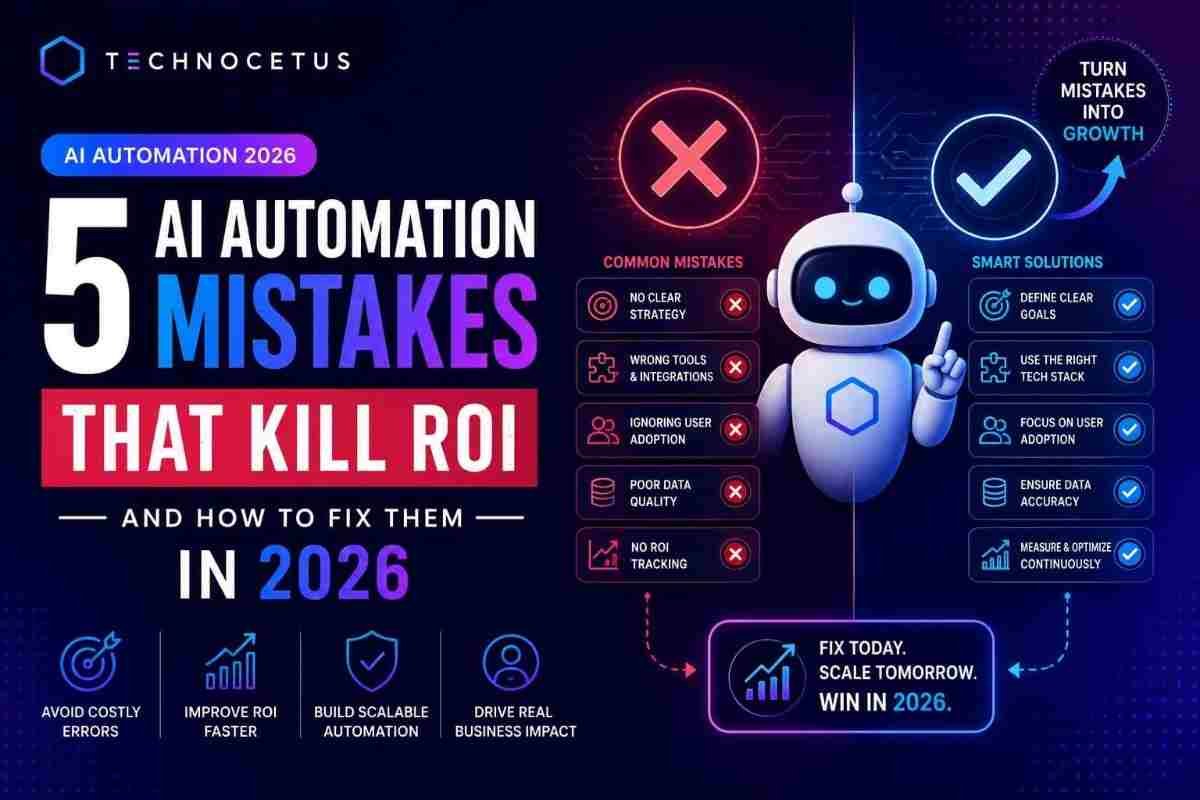
5 AI Automation Mistakes That Kill ROI — And How Smart Businesses Are Fixing Them in 2026
Businesses worldwide will spend over $632 billion on AI and automation by 2028, according to IDC. Yet Gartner estimates that 85% of AI projects fail to deliver their promised ROI. That's not a technology problem. The models are better than ever. The infrastructure has never been more accessible. The tools are genuinely transformative.
The problem is execution.
Behind almost every failed AI automation initiative is one of a small number of recurring mistakes — strategic missteps, architectural errors, and organizational blind spots that don't show up in the vendor demo but surface brutally in production. These mistakes aren't exotic. They're predictable. And they're almost entirely avoidable.
This post names the five most expensive automation mistakes businesses are making right now, explains exactly why they destroy ROI, and gives you the framework to avoid — or recover from — each one.
Why Most AI Automation Projects Underdeliver
Before the list, a diagnostic truth: most automation failures aren't technology failures. The machine learning models work. The APIs connect. The dashboards populate.
What fails is the layer between the technology and the business outcome — the process design, the change management, the governance structure, and the measurement framework. Organizations that treat AI as a technology purchase rather than an operational transformation almost always end up with expensive tools that nobody uses, or worse, tools that are used incorrectly at scale.
The five mistakes below are where that gap most commonly — and most expensively — opens up.
Mistake #1: Automating Broken Processes
The mistake: A company's invoice approval process takes 14 days and involves six handoffs, three email chains, and two spreadsheets. Leadership decides to automate it. Twelve weeks and $400,000 later, they have an AI-powered invoice approval process that takes 14 days and involves six handoffs — now executed digitally.
This is the single most common and most expensive automation mistake: applying AI automation to a process that is fundamentally broken without first fixing the process.
Automation amplifies what's already there. Efficient processes become faster. Broken processes become expensively broken faster.
Why it kills ROI: The automation cost is real. The efficiency gain is not. The organization now has a digital system that requires maintenance, training, and support — but produces the same outcomes as the manual process it replaced. When the project is eventually deemed a failure, it poisons appetite for future automation investment.
The fix:
- Conduct process mining analysis before any automation scoping — tools like Celonis or UiPath Process Mining reveal actual process flows vs. assumed ones
- Apply the "Should this step exist at all?" test to every workflow node before automating it
- Fix first, automate second — even a 2-week process redesign sprint before automation scoping pays back many times over
Mistake #2: No Clear ROI Measurement Framework Before Launch
The mistake: The automation goes live. Six months later, someone asks: "Is this working?" The team pulls completion rates, uptime metrics, and user adoption numbers. What nobody can answer is whether the automation has generated any measurable business value — because nobody defined what "value" meant before the project started.
This is shockingly common. In a 2025 McKinsey survey of enterprise AI deployments, only 23% of organizations reported having clearly defined ROI metrics established before their automation projects launched.
Why it kills ROI: Without a measurement framework, there's no feedback loop. You can't optimize what you can't measure. Projects that might have delivered strong returns with adjustment continue operating at mediocre performance because nobody has the data to identify what to fix.
The fix:
- Define your baseline metrics before go-live — current process cost, cycle time, error rate, headcount hours consumed
- Set target metrics with explicit timelines — "reduce invoice processing time from 14 days to 3 days within 90 days of deployment"
- Build measurement infrastructure into the automation itself — logging, dashboards, and anomaly alerts that surface performance data automatically
- Schedule a 90-day post-launch review as a mandatory project milestone, not an optional retrospective
See our guide on building AI automation ROI measurement frameworks for enterprise deployments →
Mistake #3: Ignoring the Human Side of Automation
The mistake: A logistics company deploys an AI-powered route optimization system projected to reduce fuel costs by 22%. Drivers — who weren't consulted during design — find the AI routes counterintuitive, override them constantly, and eventually develop workarounds that bypass the system entirely. Actual fuel savings: 3%.
Generative AI and automation tools do not implement themselves. They require humans to trust them, use them correctly, and integrate them into daily workflows. When the human side of deployment is treated as an afterthought, the technology fails regardless of how good it is.
Why it kills ROI: Tool adoption is the multiplier on every automation investment. A perfect system at 30% adoption delivers 30% of its projected value. Change management isn't soft — it's the single biggest lever on automation ROI.
The fix:
- Involve end users in the design phase, not just the training phase — the people closest to the process know its edge cases better than any consultant
- Communicate the "what's in it for me" clearly and specifically — not "this will make the company more efficient" but "this eliminates the manual data entry that takes you 2 hours every Friday"
- Build feedback channels that let users report problems, suggest improvements, and see their input acted on
- Measure adoption quality, not just adoption rate — a user who logs in daily but works around the automation isn't an adoption success
Mistake #4: Scaling Before Validating
The mistake: A retail chain pilots an AI-powered inventory forecasting system in three stores. Results look promising. Leadership, excited by the potential, rolls it out to all 340 locations simultaneously. Two weeks later, regional managers are reporting stockouts in some locations and overstock in others — because the model was trained on data from the three pilot stores and doesn't generalize to the full store network's diversity.
This is the enterprise automation equivalent of building the 40th floor before confirming the foundation is solid.
Why it kills ROI: Failures at scale are exponentially more expensive than failures in pilots — in cost, in operational disruption, and in organizational trust. A botched enterprise-wide rollout can set automation adoption back by years.
The fix:
- Define explicit validation criteria before scaling decisions are made — not "the pilot looks good" but "the model achieves >90% forecast accuracy across stores with >$2M annual revenue for 60 consecutive days"
- Test across diverse conditions in the pilot — different geographies, store formats, team compositions, and seasonal contexts
- Scale in deliberate waves with defined go/no-go criteria at each gate
- Maintain a rollback capability at every stage of rollout — the ability to revert to the previous process is not a sign of failure; it's responsible engineering
Mistake #5: Treating AI Automation as a One-Time Project
The mistake: The automation launches. The project team celebrates. The steering committee closes the budget line. Eighteen months later, the automation is producing degraded results — the underlying data distributions have shifted, the process it was designed for has evolved, and nobody has been maintaining the model. The system is technically running but functionally obsolete.
Machine learning models are not software in the traditional sense. They don't stay accurate automatically. They drift. The world changes — customer behavior shifts, product lines evolve, regulations update — and a model trained on historical data gradually becomes a model trained on irrelevant historical data.
Why it kills ROI: The value of AI automation is cumulative over time — if the system is maintained and improved. Without ongoing investment, the ROI curve peaks at launch and declines steadily, often turning negative as maintenance costs continue while output quality degrades.
The fix:
- Budget explicitly for model monitoring and retraining — this is ongoing operational cost, not a one-time project expense
- Implement drift detection — automated monitoring that flags when model performance is degrading against defined thresholds before business outcomes are affected
- Assign ongoing ownership — a named team with clear accountability for automation performance, not just for deployment
- Schedule annual strategic reviews of each automation to assess whether it still addresses the right problem and whether better approaches have emerged
External resource: The MIT Sloan Management Review AI Strategy Report 2025 provides rigorous analysis of how leading organizations structure AI automation governance and ongoing investment to sustain ROI.
The Compounding Cost of Getting This Wrong
These five mistakes rarely occur in isolation. Organizations that automate broken processes (Mistake #1) typically also fail to measure results (Mistake #2), which means they don't detect the poor adoption (Mistake #3), scale prematurely based on incomplete pilot data (Mistake #4), and then defund the maintenance that would catch the model drift (Mistake #5).
The compounding effect is brutal — and it explains why so many automation investments that seemed promising at launch become cautionary tales within 24 months.
The future of work depends on organizations getting automation right, not just getting it deployed. The difference between transformative AI adoption and expensive AI disappointment is almost always the quality of execution, not the quality of the technology.
Actionable Insights: Automation Done Right
For Business Leaders:
- Require a pre-automation process audit for every significant automation initiative — no project should receive budget approval without documented evidence that the underlying process is sound
- Mandate ROI measurement frameworks as a project deliverable, not an afterthought — if a team can't define success before launch, they're not ready to launch
- Fund automation as an ongoing capability, not a series of one-time projects — organizations with dedicated AI automation centers of excellence consistently outperform those that treat each deployment as a standalone initiative
For Technology and Operations Teams:
- Build drift detection into every ML-powered automation from day one — production monitoring is not optional infrastructure; it's the mechanism that protects your ROI investment over time
- Treat user feedback as model training signal — the override patterns, error reports, and workarounds your users develop contain valuable information about where your automation is failing; instrument to capture it
- Design rollback capability before you design the automation itself — the ability to revert gracefully is a technical requirement, not a contingency plan
For L&D and Change Management Teams:
- Map the automation impact on every affected role before deployment — who does more work, who does different work, who does less work, and who loses their job are four different conversations requiring four different approaches
- Co-design training with the people who will use the system — user-generated content, peer-to-peer coaching, and embedded learning at point-of-need consistently outperform formal e-learning for automation adoption
- Celebrate adoption quality publicly — recognize teams and individuals who integrate automation effectively into their workflows; visible success stories accelerate broader adoption faster than any training program
The Bottom Line
The gap between automation's promise and automation's delivery isn't a technology gap. It's an execution gap — and it's filled by five predictable, avoidable mistakes that organizations make when they treat AI automation as a product to purchase rather than a capability to build.
Business transformation through AI is real. The organizations achieving it aren't the ones with the biggest budgets or the most advanced models. They're the ones that fix processes before automating them, measure outcomes before scaling them, bring their people along, validate rigorously, and invest in sustainability from day one.
The ROI is there. The roadmap to capture it runs directly through the five mistakes above — and directly away from them.
Keywords targeted: AI automation mistakes ROI, generative AI implementation failure, machine learning business transformation, AI automation strategy 2026, future of work automation pitfalls